🎼
Since 1990
Music Talent Class
A structured programme of theory, ensemble and individual instrument study for children with demonstrated musical aptitude — the longest-running of its kind in Penghu.
Six years of learning built on Taiwan's national curriculum, extended by island-based local studies, bilingual instruction and specialist arts classes.
Taiwan's 12-Year Basic Education Curriculum Guidelines ask schools to develop competencies — the knowledge, skills and attitudes a young person needs to act in the real world — rather than simply to cover material.
At Magong Elementary that shows up as project work, hands-on science, reading across subjects, and assessment that asks children to explain their thinking rather than recall a fact.
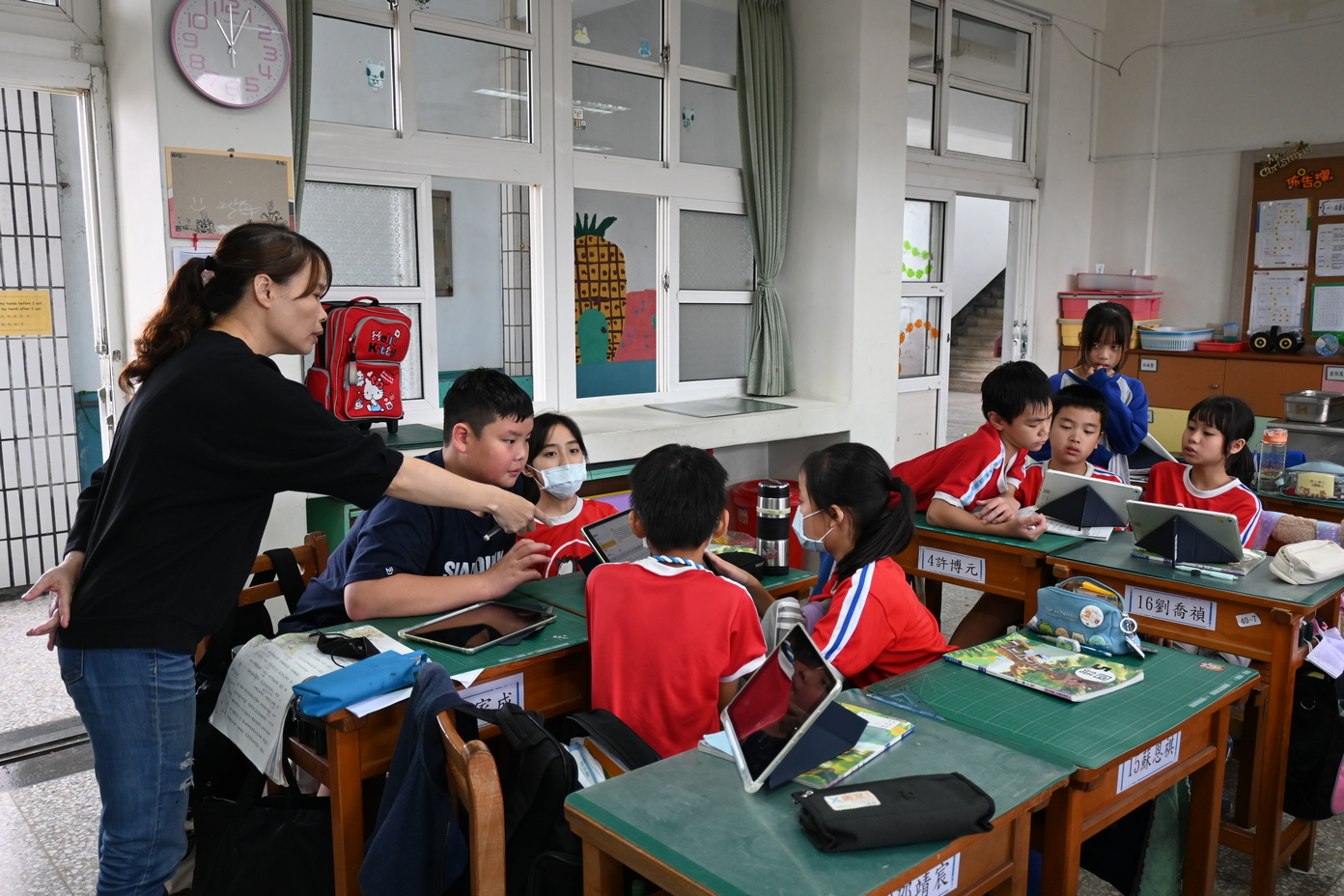
Children investigate, build, argue and present — then take what they made home to explain it again.
Grades 1–6 follow the national learning areas, with English beginning in Grade 3 and local language study throughout.
Mandarin Chinese across all six grades, English from Grade 3, and local languages — Taiwanese Hokkien, Hakka, indigenous languages and New Immigrant languages.
Number, quantity, shape, space and data — taught with concrete materials in the lower grades and increasing abstraction from Grade 4.
Natural science from Grade 3, plus information technology and hands-on making. Our annual Science Week ends in a school-wide practical competition.
History, geography and civics from Grade 3, anchored in the story of Penghu before it widens out to Taiwan and the world.
Visual arts, music and performing arts, supported by specialist teachers and the school's Music and Dance talent classes.
Swimming, athletics, inline skating, taekwondo and martial arts — several of which send teams to national competition.
Self-understanding, group life, social service and environmental awareness, delivered through projects rather than lectures.
An integrated introduction to the world for the youngest children, combining science, arts, society and health.
“Walking Mazu Palace” local studies, marine education, reading promotion and international education, all designed by our own teachers.
A structured programme of theory, ensemble and individual instrument study for children with demonstrated musical aptitude — the longest-running of its kind in Penghu.
Classical Chinese dance, ballet and modern technique, with regular public performances and county- and national-level competition.
Self-contained special classes and a resource room providing individualised education programmes, small-group instruction and in-class support.
Designated in 2023 by Taiwan's Ministry of Education — one of a small group of schools nationally trialling high-bandwidth classroom technology.
Tablets and interactive displays are used as everyday tools — for recording an experiment, filming a book review, or racing through a maths quiz together.
Students use national platforms including Yin Cai Wang (adaptive diagnosis), PaGamO, Cool English and LearnMode to practise at their own level.
Our remedial instruction programme uses the national technology-assisted platform to identify exactly where a child lost the thread — then rebuilds from there.
Children record audiobooks, host the campus radio DJ slot, and film graduation projects — technology as something you make with, not only consume.
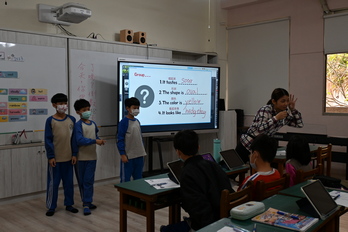
An English digital open class during our Self-Directed Learning Festival — taught in front of other teachers, then discussed together afterwards.
Good teaching is a craft that has to be practised in public. Our staff run regular open lessons, observe one another, and take part in county-wide professional development in mathematics, language arts and bilingual pedagogy.
| Period | What happens |
|---|---|
| Semester 1 Late Aug – late Jan |
Opening ceremony, Teachers' Day, Sports Day, Halloween week, English recitation heats, Science Week, Christmas carolling |
| Winter break Late Jan – mid Feb |
Winter camps, make-up learning support, teacher professional development |
| Semester 2 Mid Feb – end Jun |
Arts festival, county language and arts competitions, swimming programme, field studies, graduation projects and ceremony |
| Summer break Jul – Aug |
Summer camps, new student orientation, class allocation and teacher assignment |
Exact dates follow the Penghu County school calendar published each summer. See the Chinese site for the current academic year calendar.
Bilingual subject teaching, foreign teachers, Free Talk, audiobooks and international education — all on one page.