
Weekly
1 · Free Talk
An open English conversation station staffed by our foreign teachers. No marks, no script — children come during break, pick a topic card and talk. Shy children start by listening; by the third week most are talking.
English at Magong Elementary is not a subject you sit through. It is something you use — at break time, on stage, in the corridor, and in the recording booth.
Follow the places, tastes and sounds our students have explored on campus.
Discover the stories behind our themed meals, with learning cards, school lunch photos and questions for students.
Explore the lunch stories →
THURSDAY RADIO · 國際音樂選播Meet our student DJs and listen to songs selected for each country, with notes on what makes the music distinctive.
Meet the student DJs →
Penghu is small and far from Taiwan's main island. It would be easy for children growing up here to assume that the wider world happens elsewhere. Our bilingual and international education programme exists to make sure they never think that.
We began trialling bilingual instruction in 2021 and have been building the programme ever since — not by adding more English lessons, but by using English inside other subjects, and by creating dozens of small, low-stakes moments each week where a child speaks English to a real person for a real reason.

The English teaching team runs a whole-school vocabulary certification so every child knows exactly where they are — and what to aim at next.
Each one was designed by our own teachers and refined over several years.
An open English conversation station staffed by our foreign teachers. No marks, no script — children come during break, pick a topic card and talk. Shy children start by listening; by the third week most are talking.

English picture books turned into audiobooks — many of them narrated by our own students. Beginners hear a familiar classmate's voice, which makes the leap into English reading feel much smaller.

An after-school club where our foreign teacher supports small-group dialogue practice built around a shared story. Reading and speaking taught as one activity rather than two.

English taught with the same tools as everything else — big screens, tablets and live class response. Lessons are opened up for other teachers to watch, so the practice spreads.

School heats feed into the Penghu County English speech and recitation competition and the Chang Wen-Chin Foundation contest. Our students have taken top honours in county English singing competition.

A dedicated reading space on campus holding both Chinese and English collections. It also hosts our International Education Quest, where children hunt down answers to questions written by teachers across every subject.
A foreign teacher parachuted into a classroom once a week does very little. What works is co-planning: our local English specialists and foreign teachers design lessons side by side, so the English a child hears in a science lesson connects to the English they practised at Free Talk that morning.

Shared planning time means the English a child meets in one lesson connects to the English they used in the last.
The easiest way to learn what a culture values is to celebrate with it.
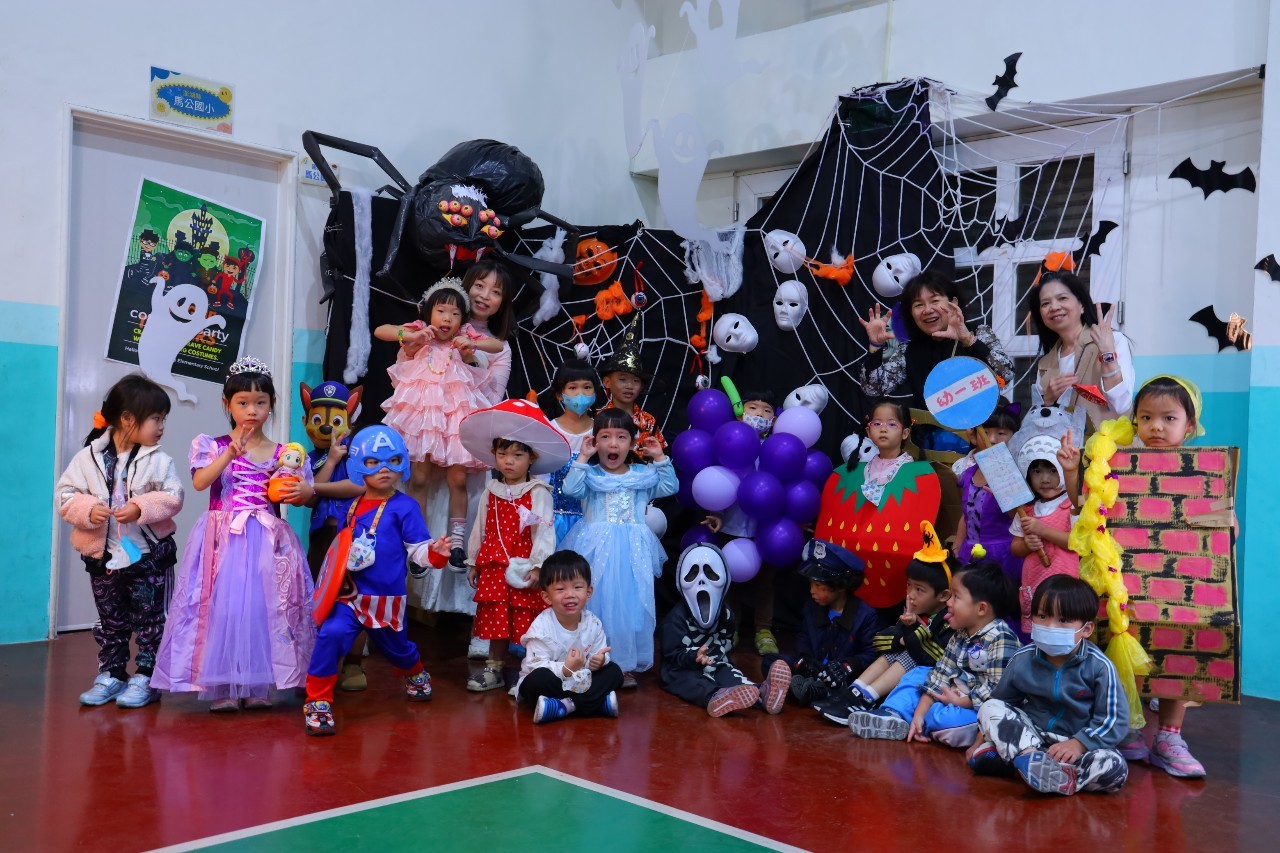
Creative costumes made from recycled materials, a whole-school runway show, and English trick-or-treat dialogues at every classroom door.

A long-standing tradition: every class takes the stage on Christmas Eve to sing English carols, combining English, music, life curriculum and performing arts in one event.

Classes decorate for festivals from around the world, supported by the school's internationalisation grant — so the calendar on the wall is never only local.
Explore Thursday World Music Radio and meet our student DJs →
International education is not only about looking outward. Since 2020 our campus has hosted the county's Indigenous Peoples Education Resource Center, supporting indigenous language and cultural education for schools across Penghu.
Alongside it, our language programme includes Taiwanese Hokkien, Hakka and New Immigrant languages — reflecting the actual families who send their children here.
Ask us about the centreWe welcome sister-school relationships, teacher exchanges and video-conference partnerships with schools overseas.